

Categories
COVID-19 Medical Updates

Johns Hopkins-supported App to Guide Covid Patients at Home in India

A team of developers in India has created a new app that is supported by Johns Hopkins University in the US and designed to guide people isolating at home after testing Covid-19 positive, right on their smartphones.

The Vee+ Svasa app — developed by Bengaluru and New York-headquartered IT services company Vee Technologies, and made possible by the Valliappa Foundation — delivers educational videos, information about accessing local medical care and Covid vaccines, and other content sourced by medical experts, right to users’ smartphones.

Created by a team of software developers of Vee Technologies located in Bengaluru and Salem, the app has sourced content and expertise of medical practitioners at Johns Hopkins University and Medicine in the US, the company said in a statement.

The Vee+ Svasa was enriched by the inputs of nearly 100 teams of students from Sona College of Technology who competed for a Rs 1 lakh student prize.

The winning teams that emerged from this competition — Senthil Sivaraman S, Harsh Vardhan SM, Ragul P and Shreinik Jain U — were chosen to support the app building and running process.

“We reached out to Johns Hopkins India Institute to give access to the globally accepted standard of care protocols for home isolation cases. For Indians battling the Covid pandemic, this would be immensely helpful,” said Valliappa Foundation Trustee Chocko Valliappa.

The home quarantine app has a wealth of authentic information ranging from treating oneself at home to how to isolate oneself and protect others in the family, to tips for caregivers on measuring oxygen saturation levels as well as an easy-to-understand Covid treatment flowchart.

The information and health protocols presented in the app come only from authentic sources, such as Johns Hopkins University, the Indian Council of Medical Research (ICMR) as well as the All India Institute of Medical Sciences (AIIMS).

“We were overwhelmed by the instant response of Johns Hopkins Medicine International President of global ventures and executive VP and doctor, Mohan Chellappa and his colleagues of Indian origin, to help us gain access to the globally accepted standard of care material,” Valliappa added.

The app will also feature existing services offered by state governments like locating hospital beds, vaccination centres, and doctors on tele-consultation in key cities.

The app is available on Google Play Store while iOS version of the app will be launched soon.
source: https://www.news18.com/
Categories
Uncategorized

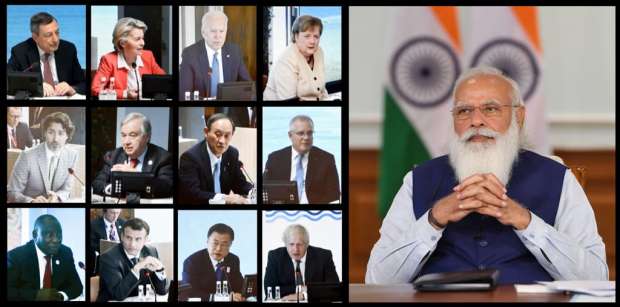
From PM Modi’s ‘One Earth, One Health’ mantra to G7 global Covid vaccine pledge: 10 points

The Group of Seven (G7), comprising the United Kingdom (UK), Canada, France, Germany, Italy, Japan and the United States (US), met on Saturday to discuss priority areas, amid a pandemic that has ravaged economies and pushed healthcare to an edge across the world.

Of all, the health crisis owing to the ongoing coronavirus pandemic dominated the G7 summit as Prime Minister Narendra Modi called for a “One Earth, One Health” approach,  Canadian PM Justin Trudeau emphasized the need to build a consensus on “how to work with China” and the G7 announced its global Covid vaccine plan.

During the G7 summit, the “Carbis Bay Declaration” was also adopted which will see the world’s leading democracies commit to a series of measures that are designed to quash future pandemics within the crucial period of the first 100 days.

But some campaigners did not invite the G7 global vaccine plan to vaccinate the poorer countries. They say it “lacked” ambition, was “too slow” and showed the G7 leaders were not yet on top of tackling the worst public health crisis.

1) PM Narendra Modi called for global unity, leadership, and solidarity to prevent future pandemics and sought the support of the G7 grouping to lift patent protections for Covid-19 vaccines. PM Modi called for adopting a “one earth, one health” approach to effectively deal with the coronavirus pandemic globally. “The prime minister committed India’s support for collective endeavors to improve global health governance. He sought the G7’s support for the proposal moved at the WTO by India and South Africa for a TRIPS (Trade-Related Aspects of Intellectual Property Rights) waiver on Covid related technologies,” the statement said.

2)  UN Secretary-General Antonio Guterres has extended support to India and South Africa’s initiative at the WTO to waive intellectual property protection for Covid-19 vaccines and products, though he cautioned that “technology transfer” must be backed up by “technical support”.

3)  The US and Australia have backed the initiative by India and South Africa at the WTO, seen as a breakthrough in the global fight against the deadly pandemic, raising hopes of expanding the supply of vaccines at affordable rates for developing/underdeveloped nations.

4) Britain will set up a new animal vaccine development centre that will aim to stop viruses jumping into the human population, to prevent future pandemics, as part of a landmark global health declaration to be agreed by G7 world leaders at Carbis Bay in Cornwall on Saturday. The move comes amid growing demand for a more thorough investigation into the origin of the virus that causes Covid-19 infections. 

5) British Prime Minister Boris Johnson, the summit’s host, has said the group would pledge at least 1 billion doses, with half that number coming from the United States and 100 million from Britain over the next year.

6)  The head of the World Health Organisation has welcomed the vaccine-sharing announcements coming out of the Group of Seven summit but says “we need more, and we need them faster.”

7)  Canadian Prime Minister Justin Trudeau led a G7 discussion of China on Saturday and called on leaders to come up with a unified approach to the challenges posed by the People’s Republic, a source told Reuters. G7 leaders reached broad alignment on building a concerted approach to China.

8) Hundreds of environmental protesters took to the Cornish seaside in a bid to draw the attention of world leaders and the international media outlets that have descended on southwest England for the G7 summit. Some protesters paddled out to sea, while others sunbathed on the beach wearing masks of leaders’ faces.

9) Meanwhile, G7 leaders will commit on Sunday to increasing their climate finance contributions to meet an overdue spending pledge of $100 billion a year to help poorer countries cut carbon emissions and cope with global warming.

10) G7 leaders are also expected to set out action to cut carbon emissions, including measures such as ending almost all direct government support for the fossil fuel energy sector overseas and phasing out petrol and diesel cars.

Categories
COVID-19 Government Guidelines Uncategorized

Pune ranks first, Delhi-NCR at bottom among top 8 cities in health infra

When it comes to health infrastructure, Pune is the most equipped city in India, shows a recent report by online real estate portal, Housing.com. The Delhi-National Capital Region (NCR), which covers the national capital, Gurugram, Faridabad, Noida, Greater Noida and Ghaziabad, was ranked the lowest in the list, primarily because of the region’s poor scores on air and water quality, sanitation and performance of municipal bodies.

Pune offers 3.5 hospital beds per 1,000 people. This is much higher than India’s national average, where there is only half a bed available per 1,000 people in the public healthcare system, shows the report, titled ‘State of Healthcare in India’, by the Elara Technologies-owned online realty firm.

According to the report that ranks health infrastructure in the country’s most urbanized eight cities of Ahmedabad, Bengaluru, Chennai, Delhi-NCR, Hyderabad, Kolkata, Mumbai (MMR), and Pune, through its Housing City Health Card, Pune also scored significantly high on parameters such as ease of living, water quality, as well as performance and sustainable initiatives taken by its local government.

These rankings are benchmarked against parameters such as number of hospital beds per 1,000 people, air quality, water quality, sanitation, liveability index and 40 per cent weightage has been given to number of hospital beds. However, Pune still struggles with public healthcare delivery, as is highlighted by the fact that it is one of the cities with high COVID-19 caseloads, the report added.

With nearly 3.2 hospital beds per 1,000 people, Ahmedabad is ranked second in the list, while India’s Silicon Valley, Bengaluru, is ranked third in spite of a high number of hospital beds per 1,000 people and its top ranking in the ease of living index.

India’s financial capital Mumbai and its metropolitan region (which is also the largest residential real estate market in the country with a transactional value of $2.5 billion in the first quarter of 2021) were ranked fourth on the Housing.com City Health Card, with parameters such as the number of beds, air quality, and liveability pulling its overall score down.

Hyderabad, Chennai, and Kolkata occupied the fifth, sixth, and seventh positions, respectively.

In the public healthcare system, only half a bed and 1.4 beds are available if we count public plus private hospital beds available per 1,000 people in India, the report said.

source: https://www.livemint.com/